Bring three real call examples to a standard-flow conversation
A short set of real caller situations is more useful than a long feature wish list.
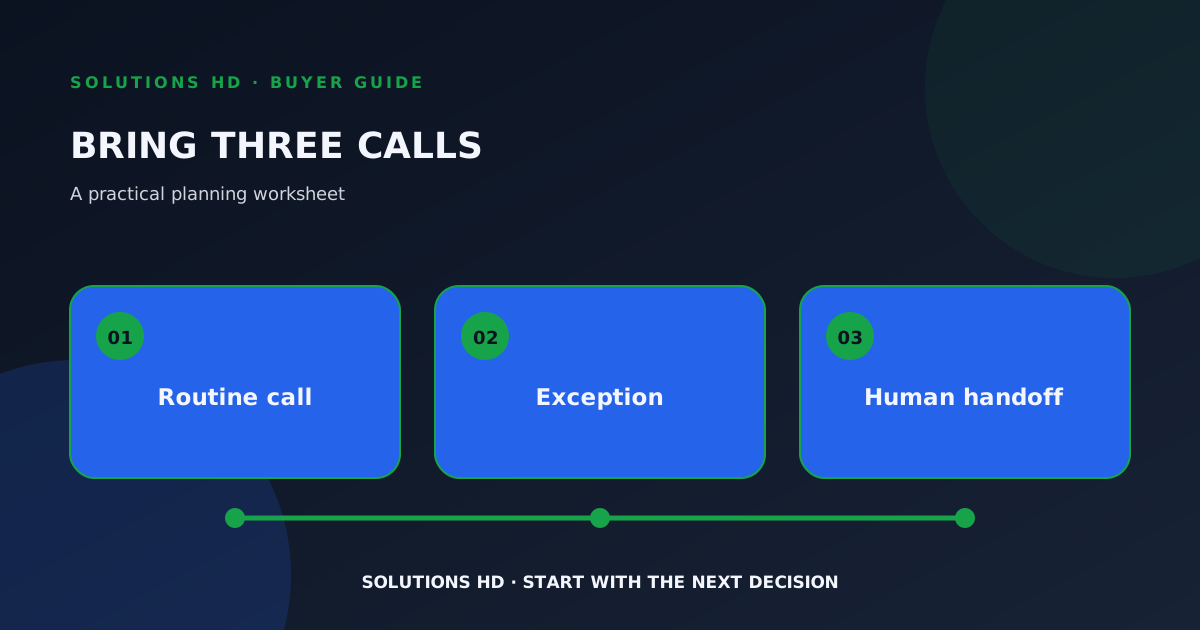
Before selecting a standard inbound path, collect three anonymized situations from your own business: a common call, a call that does not fit the common path, and one that needs a person. These examples help define the job the line must do. They do not prove a named package or configuration can handle every case.
Start with the ordinary call
Write the reason the caller contacts you and the next step your team would want. Keep it concrete: a question about hours, a request for an appointment, or a message for a named role. Record only what your business has actually approved as an answer or action. The first-job guide helps identify the dominant purpose.
Add one exception and one handoff
An exception shows where the ordinary answer stops. A handoff shows when a person needs the context. Use this worksheet rather than a fabricated product demo:
| Call type | Caller asks | Useful next step | What remains undecided |
|---|---|---|---|
| Routine | Your real common question | Your approved answer or route | None, if the answer is current |
| Exception | A request outside the simple path | Your business's review path | The choice a person must make |
| Human handoff | A request needing a named role | A receiving person or team | Context that must travel |
Illustrative: A shop may have a routine hours question, a special-order request requiring staff review, and a complaint requiring a manager. That does not establish that any Solutions HD package has those exact actions or that a transfer always succeeds.
Use the examples to make a smaller first choice
If one job covers most of the examples, begin the discussion there. If the exception would dominate the line, do not disguise it as a standard flow; clarify the scope. The exception-path guide provides a second check. Bring the three examples to Solutions HD for a conversation about the first inbound job, without assuming a package, activation time, or price beyond current published terms.